Your Biggest Competitor Might Be Your Fundraising Tool
Why the arrival of competitors in your space might be the best fundraising news you'll get and what that means for how you build.
There’s a panic that hits most founders the first time a well-funded competitor enters their space. You’ve been building quietly, you’ve found early traction, and then one morning you wake up to an announcement that somebody just raised $20 million to do exactly what you’re doing.
Your first instinct is to feel threatened.
Your second is to question whether you’re still relevant.
Both instincts are wrong.
Tayo Bamiduro built Max, one of Africa’s most ambitious mobility and clean energy companies, and watched that moment play out in real time.
Gokada, OPay and other players came into the picture. His initial reaction was the same as every founder’s: unsettled. But looking back, his read on what actually happened is more instructive than almost anything a fundraising manual could tell you.
Investors back a movement. They don’t back a company. They back a movement, but they find a company in the movement to back. - Tayo Bamiduro, CEO Max
That one sentence contains a complete reframe of how founders should think about competition, timing, and fundraising.
The Movement Thesis
Here’s what Tayo was describing, put plainly: venture capital doesn’t flow to lone geniuses with original ideas. It flows toward proven market trends, and then finds the best-positioned company inside that trend to back.
Think about how the fintech wave played out in Nigeria. From 2019 to 2022, West Africa attracted 41% of total African startup funding, with the majority concentrated in Nigerian fintech. Flutterwave, OPay, Moniepoint, PiggyVest, and Kuda all raised significant capital within a compressed window.
Was that because investors suddenly discovered multiple brilliant founders at the same time?
No.
It was because the infrastructure, the regulatory opening, and the consumer behaviour had all aligned to create a moment. Investors saw the moment and backed the companies best positioned to own it.
The same dynamic played out in African mobility. When multiple players entered the space, the sector became legible to investors as a real category. Suddenly, there was a “movement” to back and MAX, as the pioneer with the deepest operational roots, became an increasingly attractive bet, not despite the competition, but partly because of it.
This is not unique to Africa.
Uber and Lyft competing head-to-head validated the ride-hailing category far more effectively than either company could have done alone. AWS, Google Cloud, and Azure competing on cloud infrastructure made every enterprise CFO more comfortable with cloud migration than any single vendor’s marketing could have achieved. Competition, at scale, creates the social proof that turns an interesting idea into a fundable market.
The Practical Implications for How You Build
Understanding the movement thesis changes how you should think about two things:
1. How you read competition.
The arrival of a well-capitalised competitor is not a death sentence. It’s frequently a signal that your thesis is correct. When Tayp saw Gokada and OPay enter the Nigerian mobility space, the healthy response was acceleration. “When there’s competition out there, you’re on your toes more. You try harder.” More importantly, you stop being the only one making the case to investors that this market is real. Every dollar your competitor raises implicitly validates the category you’re both operating in.
What you should fear is not competition, it is being in a space so early that no investor has pattern-matched it yet, or so late that the dominant players have already locked in their advantages. The danger zone is being alone.
2. How you use your competitors.
Tayo made a point that most founders won’t make publicly: you should watch your competitors with genuine intellectual honesty, not dismissiveness. You need to be brutally honest with yourself. You never admit it publicly, but you see them, and you’re like: they’re doing this better than us. So let’s copy their strengths and add them to our own strengths.
This is how market leaders are built. Not by pretending competitors don’t exist, but by using them as a mirror, identifying where you lead, where you lag, and aggressively closing the gap.
The Caveat That Matters
None of this means competition is irrelevant.
The movement thesis doesn’t give you permission to be complacent. What it does is change the nature of the competitive threat you should actually be worried about.
The dangerous competitor is not the one raising money in your space right now. It’s the one who has found a wedge you haven’t seen, who is building the infrastructure layer underneath your business model, or who is positioned to own the next wave in your sector before you’ve finished winning the current one.
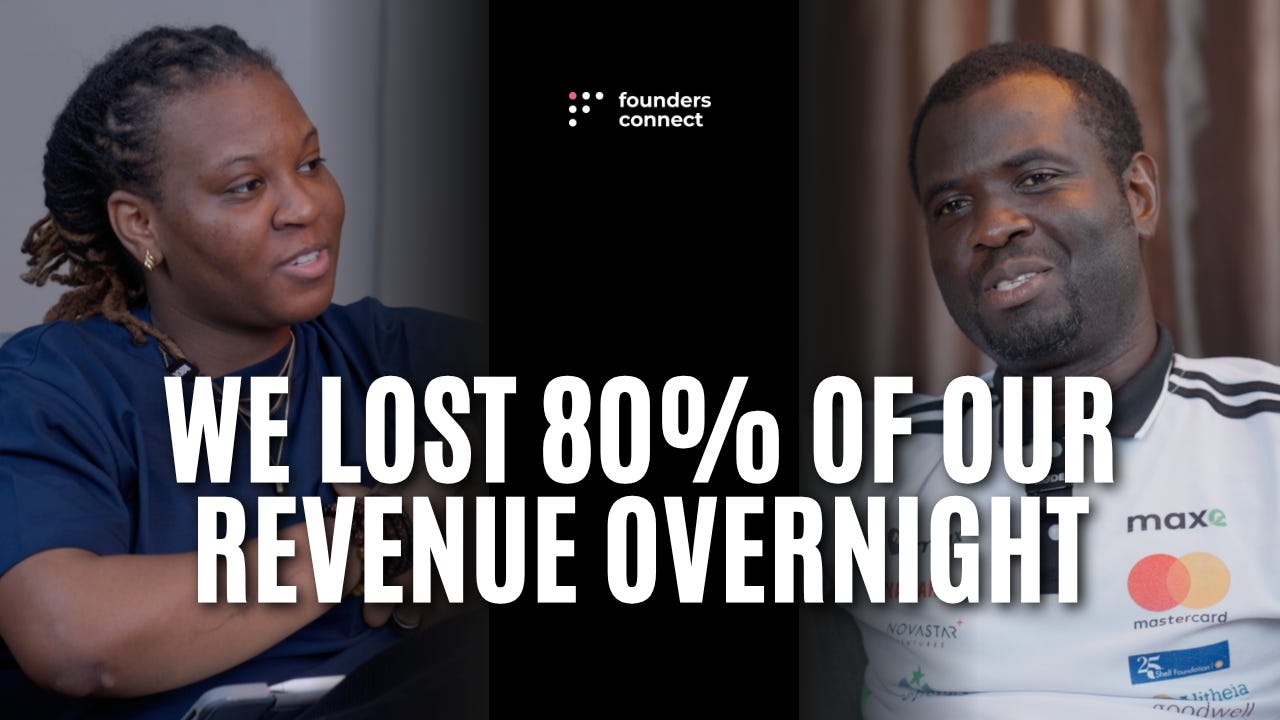
MAX understood this intuitively. When the regulatory ban on motorcycle hailing hit Lagos in 2020, forcing a shutdown of 80% of their revenues overnight, the company didn’t just survive, they used it to accelerate geographic expansion and pivot toward the deeper infrastructure play: EVs, solar charging stations, and eventually a mission to lock in energy prices for riders for decades.
The companies that were most hurt by that regulatory shock were the ones that had only ever competed on the surface.
The question worth asking about your competitors isn’t “how do we beat them this quarter?” It is “Are we building something that will still matter when the current wave is over?”
Competition tells you you’re in a real market. Your job is to make sure you’re the company worth backing inside it.
A quick note from our partner
If you’re building a career or a life across borders, every naira, shilling, or cedi counts. Sendwave makes it easy to send money from the US, UK, and Canada to Nigeria, Kenya, and Ghana. Fast and easy. All you need to do is link your debit card, verify your identity, and you’re ready to go.
You also get real-time updates so you can track your transfer every step of the way. Sendwave is trusted by over a million users, and once you try it, you’ll see why.
Use the code FoundersConnect when you make your first transfer from the US, UK, or Canada to Nigeria or Kenya, and you’ll get $10 or £10 on that transfer when you send a minimum of $10 or £10.